Transition Culture has moved
I no longer blog on this site. You can now find me, my general blog, and details of my books, on my new website.
Come find me at robhopkins.net
Archive for “Transition Training” category
Showing results 1 - 5 of 15 for the category: Transition Training.
24 Aug 2012
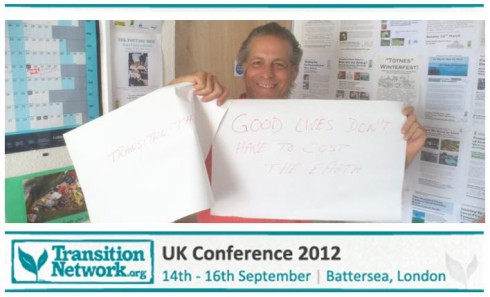
At this year’s Transition Network conference (full workshop list here), Naresh Giangrande of Transition Training is co-presenting two workshops, ‘Good Lives Don’t Have to Cost the Earth’ with Jules Peck and Inez Aponte, and ‘An Introduction to the Transition Thrive Training’. We asked him what he had planned for the workshops, and why should anyone want to go to them?
Read more»
8 Jun 2012
[A guest post from Naresh Giangrande and Mandy Dean] “Other Transition groups would give their right arm to have something like this”. Those were some of my first words to Peterborough in Transition as I rounded the corner and stepped off a busy city road and found myself in an urban oasis, bounded by the East Coast line on one side, and KFC on the other! The culture shock of coming from Switzerland; the orderliness, the way in which everything in Switzerland is just so, took a while to recover from. From a world of order- (did I say that already?), planning, government targets, suits, and a business like approach to the natural ‘chaos’ of Permaculture, doing things on no budget, begging, borrowing and liberating what you need and running on good will and instinct was more than a physical journey.
Read more»
6 Dec 2011
 Transition Training has developed a new 2-day course for Transition initiatives who have been going for some time, called ‘Transition: Thrive’. It had its first pilot a couple of weeks ago, and in this guest post, trainer Naresh Giangrande reflects on how it went, and what learnings are helping to shape its further evolution.
How well is Transition going in the UK? Is it succeeding, failing or something in between? Is there anything we can do about it when it isn’t going well? How can we help functional Transition initiatives take their next steps in a training? Last weekend, twenty six dedicated pioneers took the plunge, confronted their inner daemons and came along for a roller coaster ride of a weekend in Totnes, UK.
Read more»
8 Sep 2011
Here is a great piece by Lisa Munniksma from urbanfarmonline.com.
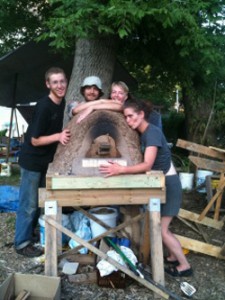
Transition training participants expressed interest in living in more natural and less oil-dependent communities.
This week, Turkey joined the growing list of countries with communities signing up to become part of the Transition movement.Transition trainer Gerri Smyth came from Gilford, England, to lead the 21 participants from western Turkey, France, Germany, Luxembourg and the United States through a two-day seminar on how communities can respond to climate change by moving away from fossil fuels and building stronger, more resilient communities.
Read more»
15 Dec 2010
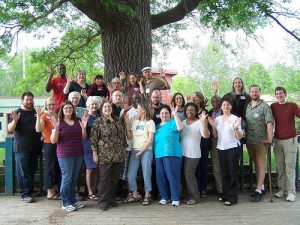
Training for Transition - Minneapolis/St. Paul, MN: May 22-23 2010.
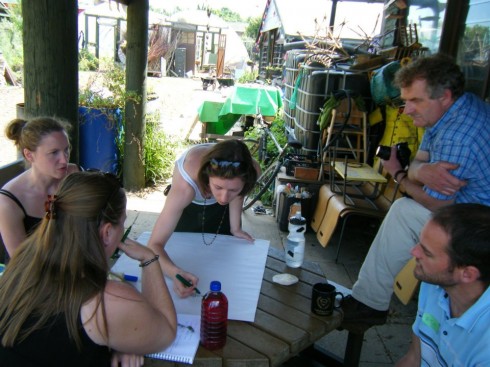
I am midway through doing one of final few remaining ‘ingredients of Transition’, this one on Transition Training, but it is all looking rather dry and boring and is rather bereft of your stories and anecdotes which are the things that bring them to life. So, I would love to hear your stories: why did your initiative organise a Transition Training? Why did you go on one? How did it help your initiative? What surprised you about it? How did it change your understanding of Transition? (Thanks to Transition US’s Flickr set for this pic).
Read more»