We’ll start this month’s round up in South Africa. We loved this video from German TV about Transition Town Greyton, and the work they are doing. Wonderful stuff. Altogether now: “Stuff your bottles, clean up your town”…
This month’s round up comes to you with a new added source of material, Twitter. There are hundreds of Transition initiatives on Twitter, and they offer a more intimate insight into what’s happening on the ground, stories that wouldn’t necessarily warrant a blog or make the local press, but which offer a great sense of what people are doing. Hopefully you’ll agree that this month’s round up is all the richer for it. Feels to me like the fullest and most vibrant we’ve yet produced.
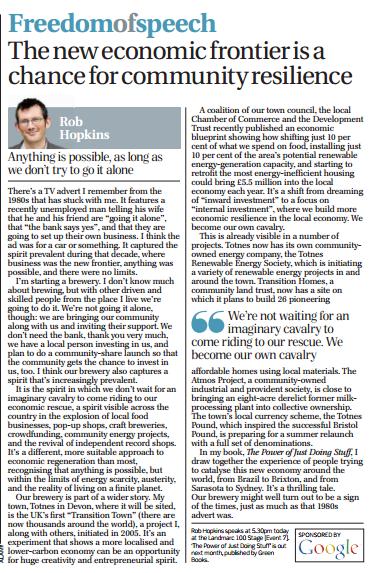
I spoke at the Hay Festival last week, a very well-attended and enjoyable session. Every day during the Festival, the Daily Telegraph produces ‘The Hayley Telegraph’, a free magazine given away at the Festival, which includes articles by, or about, some of that day’s speakers. Here is the article I wrote for the edition published the day I spoke.
The new economic frontier is a chance for community resilience
There’s a TV advert I remember from the 1980s that has stuck with me. It features a recently unemployed man telling his wife that he and his friend are “going it alone”, that “the bank says yes”, and that they are going to set up their own business. I think the ad was for a car or something. It captured the spirit prevalent during that decade, where business was the new frontier, anything was possible, and there were no limits.
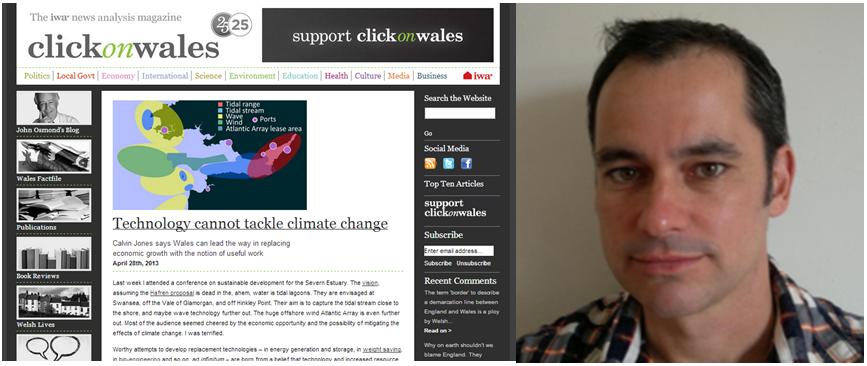
The other day I read an excellent piece by Calvin Jones, Professor of Economics at Cardiff Business School (see right) called Technology Cannot Tackle Climate Change. Having argued that, due to a range of issues, economic growth is no longer possible, he writes:
“Faced with these issues it is easy to withdraw into either a belief in an economic growth fairy, or into passive, nihilistic depression. But this is not necessary. Many societies historically have functioned perfectly well without ever-increasing levels of growth and complexity”.
He also wrote “the cognitive dissonance we feel, as GDP figures rise, and we feel ever more tired, stressed and scared, is real, and must be challenged”, rapidly becoming one of my favourite quotes. Given the challenges of condensing complex arguments into short articles, I thought it would be good to have a chat with Calvin. So what follows is either the audio file to listen to while you’re hoovering the stairs, or a transcript of our talk.
Here’s a fantastic video from DW (“Germany’s International Broadcaster”) about Transition in South Africa. It is a clip from a longer programme called ‘Global 3000: The Globalisation Program’, and it looks at the work of Transition Town Greyton in South Africa. It is a fascinating response to the question of “what does Transition look like beyond Europe and the US?” It may well become one of my favourite videos about Transition:
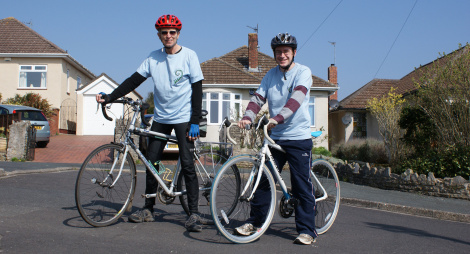
We start this month’s Round Up with the first of two awards we’ll be giving out this month, the ‘Dedication to Transition Above and Beyond the Call of Duty Award’. It goes to David and Mark of Transition Keynsham, who will be taking part in the Exmouth Exodus bike ride to raise much needed funds for Transition Keynsham. The Exodus ride is an overnight bike ride from Clifton to Exmouth, a total of around 100 miles with a few hills along the way! If you would like to sponsor them, or send them encouraging words, please click here. Every little helps (as they say).
How might our response to peak oil and climate change look more like a party than a protest march? This site explores the emerging transition model in its many manifestations
Read more»