Transition Culture has moved
I no longer blog on this site. You can now find me, my general blog, and details of my books, on my new website.
Come find me at robhopkins.net
Archive for “Peak Oil” category
Showing results 21 - 25 of 635 for the category: Peak Oil.
27 Mar 2012
A few weeks ago I travelled to Brockwood Park, a very progressive school in Hampshire, to give a talk about Transition. It was the first talk I have given that included clips from ‘In Transition 2.0’, which went down very well. I had a great time there, thanks to everyone who made it such an enjoyable visit. A few days after I went, they held their first Open Space to explore what becoming a Transition school would entail.
https://youtu.be/yBZ206SjA6A
Read more»
16 Feb 2012
Here are the notes of the talk I gave that went out just now on Radio 4’s ‘Four Thought’ programme. You can download the podcast of the programme here (which also includes the Q&A that followed as a bonus feature). I hope you enjoy(ed) it.

“It’s generally considered unwise to use props when speaking on radio, especially on your first appearance on Radio 4. However, this talk will contain two props, and here’s the first. It’s a £10 note from Brixton in London, but it’s a Brixton Pound. Rather than the Queen’s head, it features David Bowie’s. I’ll tell you more about it later, but it matters because it leads us into what I want to discuss this evening, the question of resilience.
Read more»
15 Feb 2012
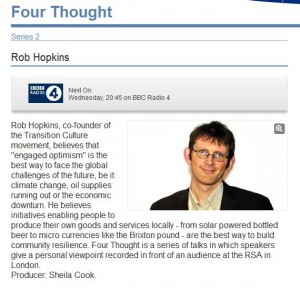 Tonight, on BBC Radio 4 at 8.45pm, you can hear the talk I gave for their ‘Four Thought’ series. Here’s how the BBC website describes it:
“Rob Hopkins, co-founder of the Transition Culture movement, believes that “engaged optimism” is the best way to face the global challenges of the future, be it climate change, oil supplies running out or the economic downturn. He believes initiatives enabling people to produce their own goods and services locally – from solar powered bottled beer to micro currencies like the Brixton pound – are the best way to build community resilience. Four Thought is a series of talks in which speakers give a personal viewpoint recorded in front of an audience at the RSA in London”.
I hope you enjoy it. I’ll post the text of it tomorrow…
Read more»
30 Jan 2012
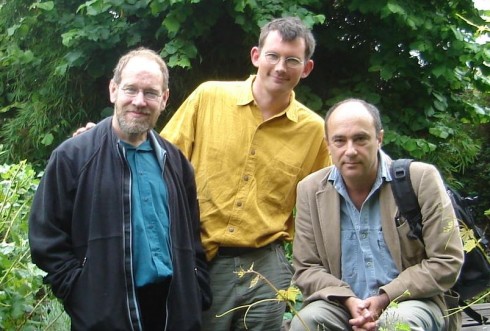
I was reminded by this recent piece by Dr Chris Johnstone over at ClimateCodeRed of the meeting that he and I held in June 2006 with Dr Stephen Rollnick. This was back when I was researching the Transition Handbook, and we met for a day to discuss how insights from the psychology of health behaviour change might be helpful when tackling environmental issues like climate change and peak oil. It was fascinating, and I realised as I read Chris’ article that I had never posted the transcript of that conversation here yet. So here it is, slightly dated, but hopefully containing some insights you will find useful (it’s quite long!). My thanks to Chris and Stephen for a fascinating day (nearly 6 years ago!).
Read more»
9 Jan 2012
 What do you do when you are the heir to the Proctor and Gamble fortune and you have spent years surrounding yourself with new agey thinking and conspiracy theories? You make a film like ‘Thrive‘, the latest conspiracy theory movie that is popping up all over the place. I’ve lost count of the number of people who have asked me “have you seen ‘Thrive’?” Well I have now, and, to be frank, it’s dangerous tosh which deserves little other than our derision. It is also a very useful opportunity to look at a worldview which, according to Georgia Kelly writing at Huffington Post, masks “a reactionary, libertarian political agenda that stands in jarring contrast with the soothing tone of the presentation”.
Read more»