Transition Culture has moved
I no longer blog on this site. You can now find me, my general blog, and details of my books, on my new website.
Come find me at robhopkins.net
Archive for “General” category
Showing results 6 - 10 of 506 for the category: General.
28 May 2013
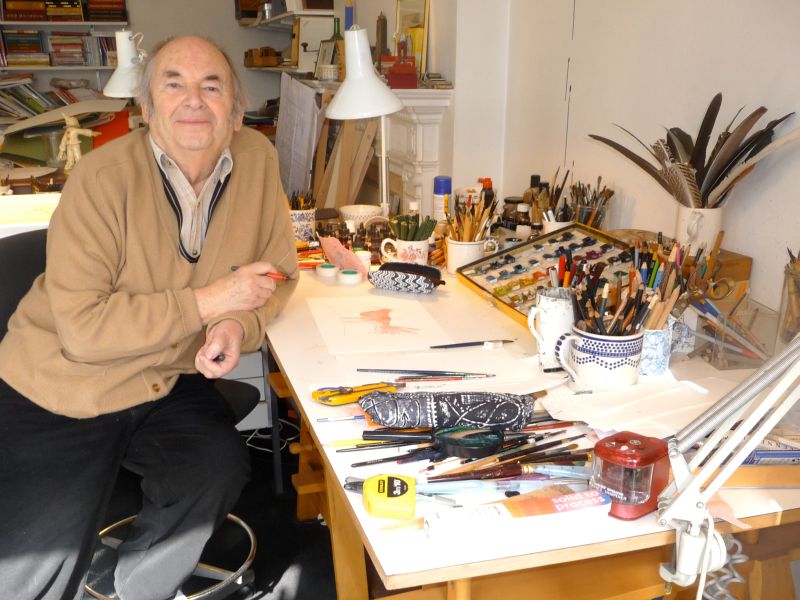
I was at Hay Festival last week and had the pleasure of spending an hour listening to one of my great heroes, the illustrator, Sir Quentin Blake. His lecture was entitled In and out of the book – the uses of illustration (you can see the transcript of his talk here). The first part of his talk looked at the role of illustration in bringing stories to life and in introducing children to the joys of reading. It was the second half of the talk though which I found most fascinating. He talked about the work he has been doing most recently in hospitals, and the power of illustration to help people in a variety of therapeutic situations and life transitions. It really got me thinking about what role illustration could play in Transition in its widest sense.
Read more»
16 May 2013
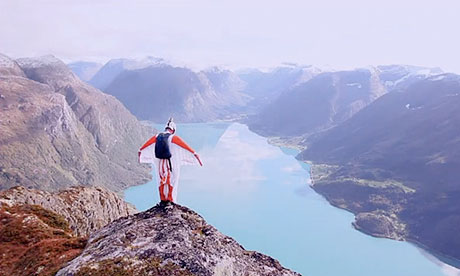
In November 2006, I sat at the back of the Barn Cinema, Dartington, and watched ‘An Inconvenient Truth‘. It had such an impact on me that by the time it ended, I had decided that I couldn’t just leave the cinema without marking the event by making some kind of change in my life. I decided that evening not to fly again, and I haven’t flown since. I have played an active part in supporting the growth of an international movement in 40 countries since then, participating in countless workshops, and discussing Transition internationally through Skype and pre-recorded talks, most of which I begin with how much carbon I have saved by not travelling in person. However, I recently watched the film ‘Chasing Ice’, and it had, if anything, a more visceral impact than ‘An Inconvenient Truth’. My resolution at the end of watching it, re-enforced by the recent passing, for the first time, of 400 ppm of C02 in the atmosphere, was that it was time to get back on a plane, and I want to use this post to tell you why.
Read more»
10 May 2013
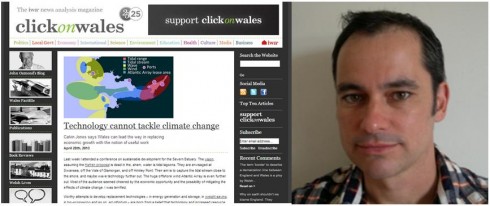
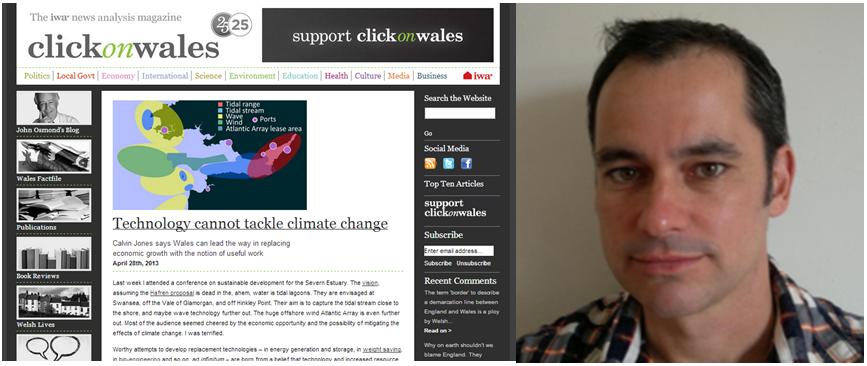
The other day I read an excellent piece by Calvin Jones, Professor of Economics at Cardiff Business School (see right) called Technology Cannot Tackle Climate Change. Having argued that, due to a range of issues, economic growth is no longer possible, he writes:
“Faced with these issues it is easy to withdraw into either a belief in an economic growth fairy, or into passive, nihilistic depression. But this is not necessary. Many societies historically have functioned perfectly well without ever-increasing levels of growth and complexity”.
He also wrote “the cognitive dissonance we feel, as GDP figures rise, and we feel ever more tired, stressed and scared, is real, and must be challenged”, rapidly becoming one of my favourite quotes. Given the challenges of condensing complex arguments into short articles, I thought it would be good to have a chat with Calvin. So what follows is either the audio file to listen to while you’re hoovering the stairs, or a transcript of our talk.
Read more»
2 May 2013
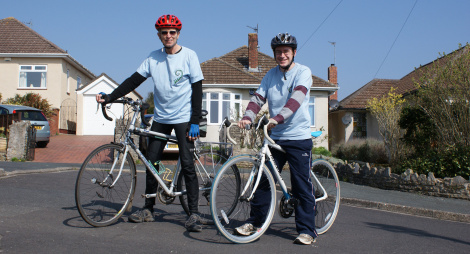
We start this month’s Round Up with the first of two awards we’ll be giving out this month, the ‘Dedication to Transition Above and Beyond the Call of Duty Award’. It goes to David and Mark of Transition Keynsham, who will be taking part in the Exmouth Exodus bike ride to raise much needed funds for Transition Keynsham. The Exodus ride is an overnight bike ride from Clifton to Exmouth, a total of around 100 miles with a few hills along the way! If you would like to sponsor them, or send them encouraging words, please click here. Every little helps (as they say).
Read more»
24 Apr 2013
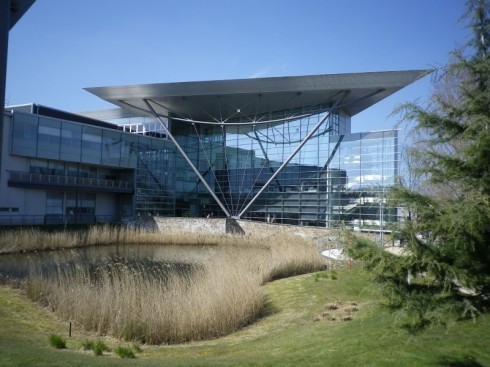
The Met Office, near Exeter.
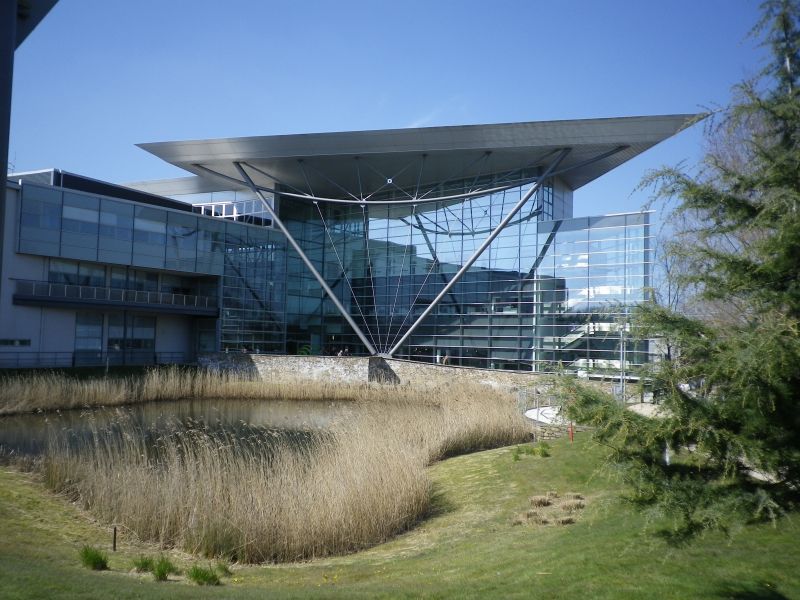
The other day a friend and I took our young sons on a tour of the Met Office’s centre near Exeter. The Met Office is home to the Hadley Centre, one of the foremost centres where climate modelling and research into climate change takes place. It was to turn out to be an event I left both angry and puzzled, and with some reflections I’d like to share here. The tour itself is of little consequence to this piece, other than to say that it managed to turn what could have been really interesting hour’s tour into a fairly tedious 3 hours, and certainly not a tour designed to sustain children’s interest. The low point for me, however, was when we actually reached the Hadley Centre. So, picture the scene …
Read more»