Transition Culture has moved
I no longer blog on this site. You can now find me, my general blog, and details of my books, on my new website.
Come find me at robhopkins.net
Archive for “Culture” category
Showing results 6 - 10 of 183 for the category: Culture.
12 Feb 2013

As Transition groups deepen their work and begin to have a tangible impact, it is, perhaps, inevitable that those who disagree may express their opinions with vigour. Over the last few months it has been my own personal experience to be on the receiving end of this in Totnes, and I have to say it has not been especially pleasant. It appears, finally, to be calming down, and so what I would like to do in this post, with the help of a few names you might recognise who have had a lot more experience of this kind of thing than I have, is to try and draw out some learnings from it.
Read more»
7 Feb 2013
Here is a beautiful short film, which will brighten any Thursday morning, about Transition in Brazil. It looks at what Transition looks like in 2 different communities there, Brasilandia in Sao Paolo, and Granja Viana. Made by the Permacyclists, it is an uplifting glimpse of how Transition is taking root there. I love the quote at the end: “A movement which brings sadness and suffering isn’t sustainable”.
Read more»
25 Jan 2013
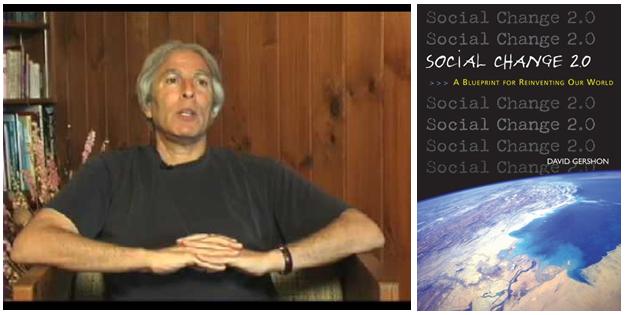
David Gershon‘s book ‘Social Change 2.0’ has been one that quite a few people involved in Transition have found useful and insightful, so I was delighted to be able to have a conversation with him recently. My discussion with him will be spread over 2 posts, one today and the second part on Monday.
David, thank you very much for joining us. I wondered if we could start by you just introducing yourself and saying a bit about who you are and what you do?
I have been a change agent, I guess you would say, for at least 30 years. My work has been around an idea called empowerment, in particular, ‘second order change’, which is another way of describing transformative social change. I have engaged in a number of initiatives of different sizes and scales from the household and block level up to the global level, and I’ve also applied this to working with organisations that want to engage.
Read more»
21 Jan 2013
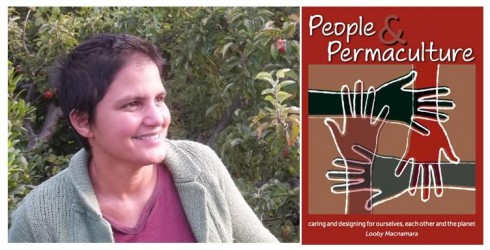
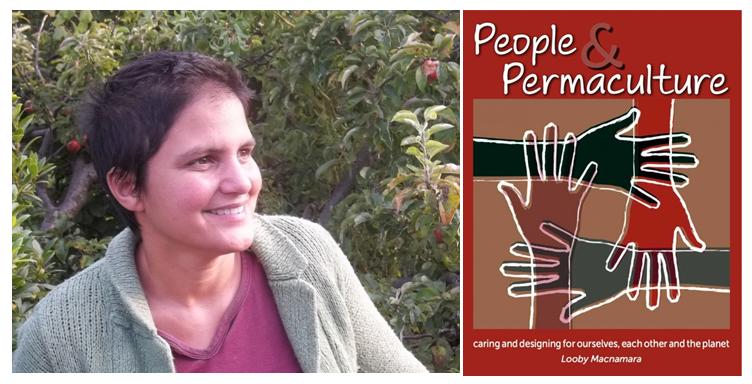
Looby Macnamara is a permaculture teacher and author of ‘People and Permaculture: caring and designing for ourselves, each other, and the planet‘. According to the publishers, it is “the first book to explore how to use permaculture design and principles for people – to restore personal, social and planetary well-being. People & Permaculture widens the definition of permaculture from being mainly about land-based systems to taking it right into the heart of our own lives, relationships and society”. I caught up with Looby via. Skype, and started by asking her how she came to the work that led to her writing the book (you can either listen to this podcast, or the transcript is below):
Read more»
11 Jan 2013
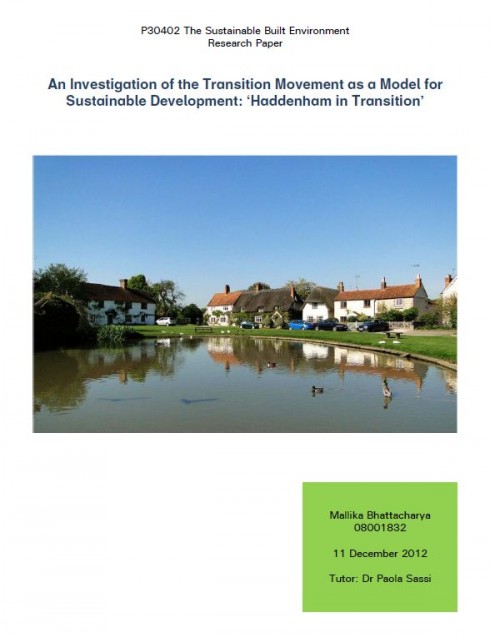
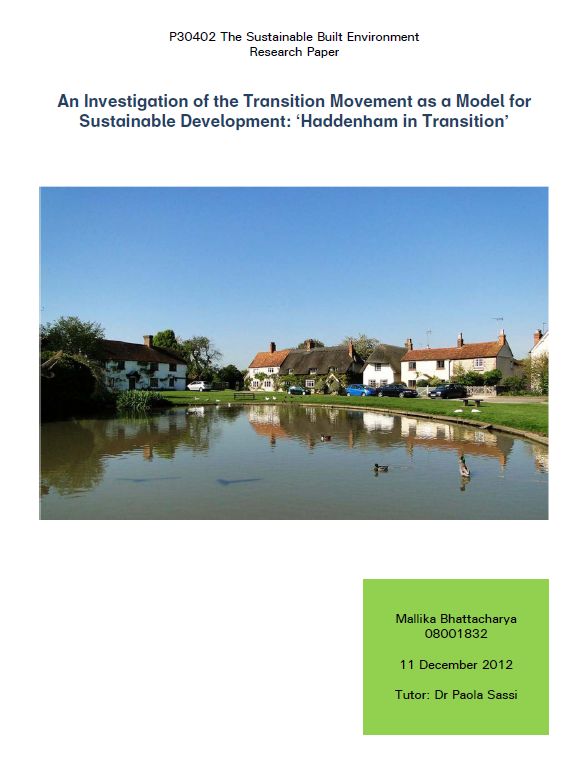
Mallika Bhattacharya, a student at Oxford Brookes University, has recently published a research paper called “An Investigation of the Transition Movement as a Model for Sustainable Development: ‘Haddenham in Transition’” (click on the link to download). Haddenham is a village in Buckinghamshire of about 8,000 residents, about 16 miles from Oxford. The research looked at the group’s work, and the level of awareness of its work across the community. The study aims to find out how aware and involved Haddenham residents are with Transition activities, what their priorities are for the village and what changes they would like to see, the Transition group’s current and planned activities and successes and issues within the initiative. It’s a very useful piece of research with some useful insights for other initiatives.
Read more»