7 Jun 2006
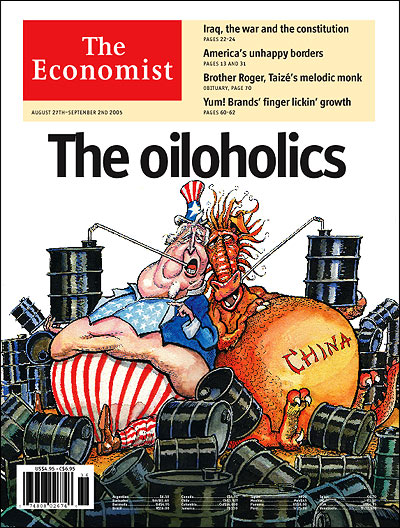
Is Our Collective Oil Dependence an Addiction? Your Thoughts Please…
 Part of the paper I am writing at the moment looks at the metaphor of addiction in relation to oil/energy dependency, which then leads on to what we can learn from innovative approaches to addiction that might prove to be useful tools for weaning communities off oil. As part of this, in one section I have used the World Health Organisation’s ICD-10 Criteria, which define what constitutes a dependency. I would really appreciate any feedback on this. What do you think? Does the comparison hold water? Are some of the criteria stronger than others? Any thoughts or inputs much appreciated. As this is work in progress and this is a draft, please do not reproduce this document without asking me first….. Thanks.
****************************************************************
 “It has been shown above that there are many different definitions of addiction, and that no universally agreed definition exists. For the purposes of this paper, it is argued here that the term dependency offers a more accurate and clearly definable description. The World Health Organisation has developed a diagnostic criteria for dependency (WHO 2002), which clearly identifies 6 criteria that constitute a dependency. Using this as our reference, the comparison with individual dependency and societal dependency to non-renewable energy services becomes clear. According to the WHO definition, in order for a behaviour to be defined as dependency, “three or more of the following manifestations should have occurred together for at least 1 month or, if persisting for periods of less than 1 month, should have occurred together repeatedly within a 12-month period:
(1) *“a strong desire or sense of compulsion to take the substance
Bev Courtney
7 Jun 7:55am
Dear Rob,
In response to your post above, I think it is difficult to compare individual dependency with societal dependency. In individual dependency, the person has chosen to use the particular substance, be it alcohol, nicotine or chemical drugs.
Looking at the 6 criteria of dependency above, I have to conclude that I am not dependent on oil; it’s simply that I have been born into a society that uses oil as its main energy source and until I discovered Peak Oil and started thinking about it, I have never questioned its universal use. Most people never question, just accept, until forced by circumstances to do otherwise and fortunately, this will happen as we go into energy descent.
It is the difference between voluntarily using a substance and being forced to use it because that is how the system operates and also feeling powerless to change the system.
The system doesn’t, on the whole, provide alternatives, e.g. public transport is almost non-existent where I live and there are no bicycle tracks; the alternative is to compete with motorists on the main roads, something akin to suicide.
Giving people alternatives is part of the answer. Building self-reliant communities is the only way to go, as you and others are constantly pointing out.
I think we need to have the alternatives ready to hit people with as they start to question, “what are we gonna do when the oil runs out?” I think also that the answers won’t come from the system, i.e. the political elites and their big-business cronies. It will come from the grassroots level, where all good things always come from.
Thanks for the great site.
Bev
Mike Bendzela
7 Jun 10:23am
I’m sorry, by I think the “addiction” metaphor is overwrought and inadequate.
It might be good to capture people’s attention, but it is not worth spending time on.
We are “addicted” to oil the same way we are “addicted” to oxygen. I use this to point out the absurdity of the term in relation to petroleum.
We have much bigger issues than which metaphorical statement is the most precise.
“Addiction” is about a body’s physiological relation to some substance. We are not drinking oil or shooting it into our veins.
“Addiction” also activates all the substance abuse treatment scams and quackery that is current the rage in society. The most apt evisceration of the AA/Recovery cult can be seen here:
http://skepdic.com/sat.html
All the therapy, counseling, and “group work” is irrelevant to peak oil.
All the “serenity prayers” in the world is not going to help us.
Andy Collins
7 Jun 11:58am
You have sketched some compelling parallels between substance misuse and societal oil addiction, Rob. But, an addict can only begin to act meaningfuly when he has both understood the nature of his problem and accepted the urgency with which it must be addressed.
Using your analogy, I suspect that mainstream Western society is still at the stage of, say, the busy executive alcoholic who works and plays hard and relies totally on booze to get him through the day. He manages for the moment to hold down his job and has, as yet, concealed the extent of his problem from most of his family and friends and even himself.
Basically, he still considers himself to be a social drinker … all his work peers live in the same way he does, and he is not aware of a practical or even desirable alternative to his current lifestyle. Sure, he has heard the odd note of caution, but not from anyone he takes seriously. His boss (read: government) certainly has an idea of what is going on, but either doesn’t care enough as long as the job gets done, or doesn’t really want to get too involved. For now, then, his priority is to cope in the short term and, lets be honest, he has not even properly begun to recognize he has a problem. His drinking is a mere social activity – so what if he needs it to get through the day?
This is the comparative stage of alcoholism I believe mainstream Western society is at with regard to peak oil and related problems.
We are simply on the fringe of awareness – utterly unable to act meaningfully until confronted face to face with the consequences.
Obviously, education is the key, and that’s why your work is so important, Rob. And yet our alcoholic friend still hasn’t grasped the message and doesn’t have time to listen – right now he is pretty busy just coping day to day. As his friends and family, we can hardly bear to watch, yet preaching or beseeching is ineffective for now. So maybe, we just have to show by our own actions that life is possible (and even pleasurable) without the addiction. We need to stay in touch with him and be there ready when he realises he needs help. A change in his attitude could come quite suddenly as a consequence of a crisis, and by then he may not be in a pretty state, of course, but the more friends we can rally round now to help when that time comes the better….
Thanks, Rob, for what you are doing for him (us)right now through your work. Let’s hope he will thank you himself one day…
Camilla Wimberley
7 Jun 12:19pm
Just a brief thought: I would say that populations of western countries are addicted not to oil per se, but to energy, in the sense of a over-consuming, energy-intensive lifestyle. Governments recognise that to maintain this lifestyle (which, not quite coincidentally, provides highly profitable opportunities for business) they must get the oil, and so governments are addicted to oil itself.
Norm Ezzie
7 Jun 12:43pm
What I report on our nations delimma dealing with energy may just be a little too strong for most…however,educating the masses is a full-time endeavor,and there lies the twist in it all—-I fear we may have to “bite the bullet” first,before America truly comprehends our frantic call to conserve 1st,and understand that the real next step for America is,”Smart-Shrinkage”….doing more with less! All the soundbites in the world won’t solve anything.Example of what I mean here is….”if its not on TV,it can;t be true”—-Well my cyber friends…its on TV and they still don’t believe it! Want more of what we do…log on at: http://www.storminnorm.com “its all there,every damn bit of it”!
Mike Harrington
7 Jun 12:46pm
Unlike substance abuse, stratospheric oil consumption in the United States also comes from burning its bridges with a way of life that was less auto-dependent, precluding meaningful energy savings. There is no alternative living arrangement for North Americans. There are almost no walkable communites left, whereas 60 years ago, most cities and towns were pedestrian-oriented. There were huge streetcar systems and 5,000 times as many passenger trains. Architecture and public space were conducive to walking. There was little traffic and work, shopping and entertainment were close together for easy access.
Using Rob’s analogy, the addicted are being force-fed huge doses of intoxicating substances, and leaving the grog-house is against domestic public policy.
Zeke Putnam
7 Jun 1:46pm
Like you, I prefer the word dependent. When anything (substance, person, behavior pattern,etc) becomes so central to your life that you find it difficult to impossible to live without it, you are dependent on it. Obviously, this is the case with oil and energy in general. And America is the most dependent of all. We are the farthest from being able to live without it. Everything (government, media, ourselves)is working hard to keep the whole process in place. We’re at the “it’s somebody else’s fault” ie China right now. As in all forms of dependency, my behavior is seen as normal, it’s you others that are out of line. At the slightest indication of supply interruption, we whimper, cry and shout in anger. “I want my cheap gas!!” I don’t change my behavior. I want my “normal” to continue. Right now there are a number of people trying to tell America, we have a problem. It’s not going to work because reality hasn’t changed. Until reality changes, it’s an intellectual exercise. The govenment could force reality to change but they aren’t going to do that. Typically, change is introduced by an external force of some kind. If the reality challenge happens soon enough the person has an opportunity to change, if it happens too late, their life crumbles and sometimes, they die.
Doly Garcia
7 Jun 2:13pm
I don’t think “addiction” is the right analogy. Are we addicted to living in houses, as opposed to the original nomadic life? Are we addicted to agriculture, as opposed to hunting-gathering?
If a society has embraced a particular technology, I don’t think “addiction” is at all the right way of expressing it. Even if the technology proves to be a bad idea, because it isn’t sustainable. If a village cuts more trees than they plant for firewood, are they addicted to wood or to fire? Are they addicted to staying warm? No, they are just short-sighted. That may be a common feature with addicts, but there is one big difference: addicts can always live without their addiction, but technologies may be necessary for life to certain people, even if that technology is unsustainable in the long term.
It isn’t a matter of giving up oil, and after a while of gritting our teeth, we’ll be fine. It’s a matter of finding a substitute to technologies that are right now essential to our life, because those technologies can’t keep us going any longer. In other words, we aren’t talking about unpleasantness. We are talking about life and death.
JMG
7 Jun 2:53pm
Addiction, the trendy new word, is used for the same reason that people who choose to pursue substance abuse use it: it suggests that they are not responsible for their actions.
The medical model of addiction (as opposed to the behavioral one) is a product of one thing: DRGs, the medical billing codes that determine who gets paid and for what in the medical-industrial complex. Until DRGs, addiction was recognized as a behavioral issue that required behavioral change. When clever medical folks figured out that they could BILL for this at their rates–rather than at the low rates typically given for behavioral change folks–suddenly we had DRGs and then we had a whole new model of addiction.
If we’re addicted to oil it’s a strange addiction because it’s the first one where we will feel better throughout the withdrawal and substitution process.
If anything, I would guess that it’s the corporations who are _addicted_ to keeping us _dependent_ on cheap fuel.
Donna Jones
8 Jun 1:46am
This is a painful subject. Looking at myself, even though our family does much to reduce, reuse, recycle and conserve, there is still a part of me that says…”the end of easy oil is coming, so what do I want now that will be hard to get? A vacation by airplane? Plastic pvc pipe? Foam insulation?” It is actually painful to me to consider that we will have to do without so many things in the future, and my own denial kicks in. So, it is essential IMHO to deny myself now so that I can truly understand what is coming for everyone… This is going to be unpopular, but the only voice that carries true authority is that of the person who does what they say.
mark robson
8 Jun 3:01am
I was getting a haircut a few weeks ago and the discussion in the barber shop came to our use of cars. After listening to me patiently about Peak Oil the barber replied,
” We are as addicted to our cars and use of petrol as a drug addict is addicted to ( say ) heroin.” He made this statement before George Bush’s famous addicted to oil remark.
The withdrawal from our addiction will be as difficult and painful as that of a heroin addict, but the level of understanding I got from a small barber shop amazed me. The people can and do understand the issues, and perhaps can be convinced to get out of their cars; but I doubt it, I am pessemistic about our ability to shrug off our car culture.
I rode my pushbike to work today, and I saw precisely zero others doing the same.
Graham Strouts
8 Jun 6:03pm
I think the addiction is not to the oil per se but to the lifestyles it provides, specifically to consumerism- “Shop till you Drop”. I think the analogy holds good when thought of in this way, adiction to shopping, to consumerism in general, a lifestyle which is way beyond what we actually need to survive or even be comfortable. For eample, I live in West Cork, one of the most idyllic holiday locations on the planet, but many peopl I know who live here have a strong ned to fly somewhere else every year for recreation, and would feel hard done-by if they could not do this.
The general need to keep buying stuff, shopping as recreation and general “growth” does I think have all the hallmarks of adiction, as Rob points out.
We dont need oil in the same way we need oxygen- the latter is simply a precondition to life. Consumerism- a lifestyle only possible because of the unique properties of oil which allow a sizeable minority to spend much of their time simply consuming- is addictive and I think the panic that Peak Oil can bring on in some people may be as much a response to the deeper fears of having to face ourselves and ask what life is really all about when our high-energy “displacement activities” of TV and shopping and foreign holidays are cut off.
Steve Hinton
9 Jun 4:32pm
First of all, addiction is natural. It seems to be the flip side of human adapatability. It is as if we must run the risk of addiction in order to have our felxibility. (more on that later)
Other words close to addiction are dependency and abuse – worth exploring as well.
If you think of work abuse, or workaholics, its a situation where the unfortunate person gets their kicks increasingly from work, and from nothing else. The test for workaholics includes the question “do you read work related stuff at the dnner table, in bed, etc?”
The thing is ABUSE where it affects other aspects fo your life negatively. Obviously just because we go to work we are not addicted.
Many say we are addicted to short term hits of happiness – we cannot be still and content.
You could certainly say that we abuse oil in this context because, like the workaholic, it is increasingly through oil fueled activities we get our kicks.
In fact I’ll ask you readers the same question. Can you think of something you really enjoy doing that does not require oil?
Of the kicks and hits of happiness you get for yourself, what percentage are energy-intensive?
Studies of addicts show that when they are shown someone taking “the drug” their frontal brain lobes are stimulated as if they were experiencing the buzz. So addicted has a brain element, like anticipation. When given drugs to suppress this frontal lobe activity alcoholics were miraculously cured. AND they lost weight as they became less “eating” addicted.
The cure for oil addiction would be the one, through drugs or therapy, that stopped this anticipatory mechanism.
so when you look at a cool car …. nothing.
The thought of an executive job in industry ..nothing ..thought of holiday abroad… etc.
This anticipatoy mehanism I believe is inbuilt to help humans survive in many situation. Like digging the garden, growing food, building eco-houses, recycling etc would become “anticipatory good”.
I would love to run therapy groups on that!
Cindy
10 Jun 8:25pm
There is no standard medical definition of addiction, but I don’t believe this word applies exclusively to substance abuse in any case. Here is a page written by Howard J. Shaffer, Ph.D., C.A.S. that discusses the definition:
http://www.divisiononaddictions.org/html/whatisaddiction.htm
Also, IMO, “society” does not force us to burn up absurd amounts of fossil fuels. When we deny our individual choices, we give up responsibility, and then you have the situation we have today.
Robert Younger
11 Jun 9:38pm
My understanding of addiction as opposed to dependency: 1) addicts inability to countenance living without addictive substance 2) the knowledge that carrying on substance abuse as before is dangerous 3)fear of running out and extreme action to avoid this
In the case of 1) people seem genuinely unable to accept that cheap energy (oil) is limited and due to run out soon, hence cornupocian arguments
2) We know the damage that our unfettered use of cheap energy is wreaking on the planet and once again people seem blindly unmoved by the long term damage being caused
3) the prospect of shortage already seems to move government to extreme action as evidence in Iraq.
Surely all three of these reactions could be seem as mentally aberrant behaviour induced by addiction. Incidentally the level of that addiction may be measurable using price elasticity of demand say
Fantastic web site
David Huck
20 Jun 5:52pm
I certainly agree with many of your comparisons between addiction in individuals to addiction in society. While there are certainly many problems with simply applying the entire coda of addiction treatment (which isn’t as myopic and dogmatic as Mike B. says, at least nowadays) to society at large, the lessons learned from addiction psychology as a whole seem to be of great value. Specifically, I’m reading Carlo DiClemente right now, per your suggestion, and am finding many of his ideas to be useful organizing concepts for peak oil work. Of course we’re not going to sit everyone down in a room and talk to them about stimulus control (though this may work with individuals who really want to drive less, but are having trouble doing otherwise despite availability of alternatives); however, the idea that a firm and well considered decision–pros and cons–needs to be the basis of lasting change, seems to be correct.
Addiction is an excellent metaphor if applied selectively with an understanding of what we are faced with as a society and as individuals as well as how addiction plays out in real life. Remember that not everyone recovers, in fact many addicts die fighting (or in apathy). Since I can see that as a possibility for our culture, I think we should work strongly in the opposite direction.
Dennis Meaney
23 Jun 11:33am
I think of my past teenage years, driving around and wasting gas; contributing to depleting oil and killing us off at the same time.
gerg
13 Jul 9:54pm
Im finding this dialogue between individual and colective addiction great. Reviewing the posts im seeing that how one answers this addiction question depends upon their concept of agency/self-determination and institutional organization.
So thoughts
—How much control do we have over our own life? Over our consumption of oil? (This has been of great joy seeing people seek for these anwers through the emerging awareness of a possible drawdown of our energy-intense lifestyle.)
—Can people or societies be addicted to convenience (not saying one way or another if fossil fuel consumption is convenient in the ultimate sense)?
Could it be that we are addicted to conveinence? And oil is our enabler?
On a final note:
-Sociology, has a lot to offer the subjects of collective behavior, movements, etc.
-Fossil fuel usage seems to be a choice, its not the only way/means to live a fullfilling life. Which astounds me, when i continue to see the strength of the connection people have equating things with happiness ie quality of life. Things of which never could be present without fossil fuels–since most every-thing is a product of an industrial system.
Noah
17 Dec 2:22pm
Where are the footnotes referenced by the internal citations in this article?