You are at: Home » The Curse of the Were-Rabbit as a …

Transition Culture

An Evolving Exploration into the Head, Heart and Hands of Energy Descent


25 Feb 2006

The Curse of the Were-Rabbit as a Post-Apocalyptic Utopia

wg1*A couple of months ago at **Transition Culture** I explored the fact that I and others had been unable to think of a movie that showed a positive example of how a post-peak world could be. We could think of plenty of Matrix-style nightmare scenarios, but nothing that looked at how a low-energy future could be in such a way as it might be both achievable and desirable. I was delighted therefore to read **Albert Bates**’ article, which he has kindly given permission for me to reproduce below. I finally got to see the film in question the other day, and concur with Albert’s take on it, as well as thinking what a great film it was… .*

**The Curse of the Were-Rabbit as a Post-Apocalyptic Utopia – by Albert Bates**

Its not easy putting together a vision of the world after petroleum. When Jimmy Carter did, 3 months into his too-short hire as President of the United States, it looked a bit too much like the world during petroleum.

Carter’s historic speech began with dire predictions if we failed to make 1977 our turnaround year:
wg2*”If we do not act, then by 1985 we will be using 33 percent more energy than we do today. [In 2005 the USA will use nearly 100 quads, up 35% from 1977.] We can’t substantially increase our domestic production, so we would need to import twice as much oil as we do now. [In 1977 the USA imported 35%, today it imports 56%.] Supplies will be uncertain. The cost will keep going up. Six years ago, we paid $3.7 billion for imported oil. Last year we spent $37 — nearly ten times as much—and this year we may spend over $45 billion. [In 2005 the USA will spend approx. $90 billion.]
Unless we act, we will spend more than $550 billion for imported oil by 1985 — more than $2,500 a year for every man, woman, and child in America. [Today it is roughly $320 per capita; $980 per person per year in 1977 dollars.] Along with that money we will continue losing American jobs and becoming increasingly vulnerable to supply interruptions.*

*We will feel mounting pressure to plunder the environment. We will have a crash program to build more nuclear plants, strip-mine and burn more coal, and drill more offshore wells than we will need if we begin to conserve now. Inflation will soar, production will go down, people will lose their jobs. Intense competition will build up among nations and among the different regions within our own country. If we fail to act soon, we will face an economic, social and political crisis that will threaten our free institutions. But we still have another choice. We can begin to prepare right now. We can decide to act while there is time.”*

Hiking up the sleeves on his cartigan sweater, Carter then proceeded to run through a 10-point plan to cut oil imports by two-thirds, insulate 90% of US homes, and put solar panels on millions of roofs, beginning with 1600 Pennsylvania Ave. But he warned people that it wouldn’t be all peanuts and Billy Beer.

*”I am sure each of you will find something you don’t like about the specifics of our proposal. It will demand that we make sacrifices and changes in our lives. To some degree, the sacrifices will be painful—but so is any meaningful sacrifice. It will lead to some higher costs, and to some greater inconveniences for everyone. But the sacrifices will be gradual, realistic and necessary. Above all, they will be fair. No one will gain an unfair advantage through this plan. No one will be asked to bear an unfair burden. We will monitor the accuracy of data from the oil and natural gas companies, so that we will know their true production, supplies, reserves, and profits.*

*The citizens who insist on driving large, unnecessarily powerful cars must expect to pay more for that luxury.
We can be sure that all the special interest groups in the country will attack the part of this plan that affects them directly. They will say that sacrifice is fine, as long as other people do it, but that their sacrifice is unreasonable, or unfair, or harmful to the country. If they succeed, then the burden on the ordinary citizen, who is not organized into an interest group, would be crushing.
There should be only one test for this program: whether it will help our country.”*

—”The President’s Proposed Energy Policy.” 18 April 1977.

Carter was hinting at cultural changes, and he was definitely pissing off the Muscle Car generation and Big Steel by taxing gas-guzzlers, but fundamentally he was hoping to preserve, rather than reverse, the consumer way of life. Carter was a Green Consumer. He was rearranging deck chairs.

Carter also said, “We need to shift to plentiful coal while taking care to protect the environment, and to apply stricter safety standards to nuclear energy.� George W. Bush has said the same thing. John Kerry and Al Gore did too. So did Britain’s Tony Blair, Paul Martin in Canada, and the Liberal and National parties of Australia.

Its as if they never heard of climate change. Or Chernobyl.

There are not dim bulbs everywhere. After deciding to phase out nuclear power in 2000, Germany installed 12,000 megawatts of wind power and 500 megawatts of photovoltaic solar panels in 3 years. With green power collecting the difference, Germany was able to shut down the first of its 19 reactors in 2003. The other 18 will be shut down over the next 15 years, replaced entirely by renewable energy.

China announced in November, 2005 that it would spend about 180 billion dollars to double its use of renewable energy (to 15 percent) by 2020. While this includes solar-PV, wind and hydropower, China is developing biofuels to replace ten million tons of petroleum with renewable energy annually. China also plans to expand solar heating to 300 million cubic meters, replacing the use of about 40 million tons of coal each year.

After moratoriums and public debate, Sweden, Spain, Italy and Austria all chose to go non-nuclear. Even Belgium, which depends on nuclear power for 57 per cent of its electricity, has committed to phasing out nuclear power by 2025. All of these initiatives came about after governments allowed the issue to go to a general referendum. Given a straight up or down vote, the people chose down. It’s nice to see democracy work.

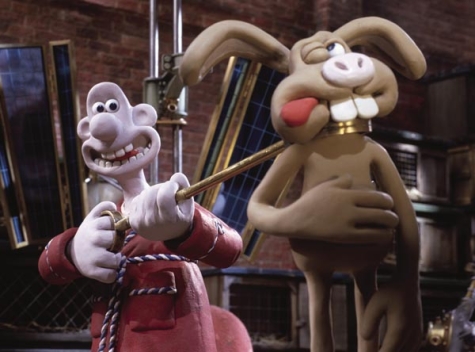
If you have been to the movies lately, perhaps you have seen Wallace and Gromit: The Curse of the Were-Rabbit. This is a pleasant-enough divertissement for a Sunday afternoon outing with the small fry. It is also a post-apocalyptic utopian vision that plants hope where other visions of petrocollapse leave fright and despair.

The plot in a nutshell: Wallace and his loyal dog, Gromit, set out to discover the mystery behind the garden sabotage that plagues their village and threatens the annual giant vegetable growing contest. They encounter a huge were-rabbit.

Claymation animator Nick Park’s home town of Preston, Lancashire provided the inspiration (the paint color on Wallace and Gromit’s van is designated Preston Green as an homage). The setting is the bucolic North of England straight out of the 1930s. And in fact Lancashire is where the idea of national walking paths originated.

The village portrayed in the cartoon is ecological and economical. Cars are few, small, utilitarian, and evidently alternatively-fueled. Every house has a vegetable garden and greenhouse. People get around mostly by foot or by bicycle, and distances are not large. An annual vegetable-growing competition is a Big Deal.

wg3Wallace is not a Luddite. He is a tinker. There is a proliferation of wacky gadgets, ranging from a machine that puts on Wallace’s boots for him to a device that catapults dollops of jam onto a piece of toast as it springs out of a pop-up toaster. Just because there is no petroleum to make poly sheathing and natural gas to make fertilizer doesn’t mean you can’t have greenhouses full of cucumbers. Even the fuddy-duddyest residents of Wallaby Lane get it.

Fast forward from 1930 England to a Galaxy Far Away. The Foundation series started as eight short stories published in Astounding Science Fiction magazine between May 1942 and January 1950. Eventually Isaac Asimov expanded it into ten volumes—about one million words.

The premise of the series is that mathematician Hari Seldon has spent his life developing a branch of mathematics known as psychohistory, which uses the law of mass action to predict the future. Seldon foresees the fall of the Galactic Empire and that there will be a 30,000-year dark age before the next great empire rises. He decides to pack his graduate students off to a distant corner of the galaxy to preserve knowledge after the collapse so that people will have something good to read. They compile the Encyclopedia Galactica, a sort of Hitchhiker’s Guide, and knowledge being power, are viewed as sort of a shamanic cult or grunge band, The Magicians.

Rewind to 1999, and a fair number of us were really worried about the computerized world, as we knew it, meeting an untimely end because of a very simple but ubiquitous programming error that began around the same years Asimov was writing for Astounding Science Fiction. So what did we do to prepare? We stockpiled a few months worth of canned goods and dried corn. We shopped yard sales for old-fashioned hand-tools. We committed our most valuable computer files to paper. Or maybe we downloaded the great masterpieces of literature to our laptops and bought solar cells to run them by. Call it Encyclopedia Galactica Lite.

These days a few of my friends are emigrating to New Zealand, Costa Rica, Canada and Mexico. As if hopping a spaceship to another planet, they downloaded the great masterpieces of literature to their laptops and bought iGo adapters so they can recharge on nearly anything.

Wallace and Gromit have a better plan. Where the Y2kers were trying to sustain their way of life—in effect surviving through the Dark Age to rebuild the Empire—and where Jimmy Carter was trying to conserve a path into technology-driven prosperity, Wallace and Gromit are building a low-tech utopia, one happy squash at a time. They have discovered a sense of place and invested in it. There is a gleeful mechanical hubris still present in their whooshing rabbit vacuums and bed-slide alarm clocks, but it is more nostalgic and improvisational then climate-altering or radioactive. It is compost modernism. There are mirrors, but no smoke. Ethical attitudes guide their tool choices. Springs. Counter-weights. They have chosen home-grown pedestrian utopia, and they make it better a little more each day.

But wait! Even the Shire is no longer safe. Dragons lurk at the edge of our map.

Five years ago Bill Joy published a lengthy screed about the trajectory of recent technology in Wired Magazine. Remembering Finagle’s law, “anything that can go wrong, will” (the fact that this is commonly known today as Murphy’s Law illustrates the point), he recounted our overuse of DDT and antibiotics and the emergence of super-resistant viruses and bacteria, and went on to describe our forays into genetics and the building-blocks of life. He said, “The cause of many such surprises seems clear: the systems involved are complex, involving interaction among and feedback between many parts. Any changes to such a system will cascade in ways that are difficult to predict; this is especially true when human actions are involved.â€?

wg4The most frightening scenarios to Joy were those that came as unintended consequences from his own life’s work. Co-founder of Sun Microsystems, he was designer of three microprocessor architectures—SPARC, Java, and MAJC. Said Joy, “The nuclear, biological, and chemical (NBC) technologies used in 20th-century weapons of mass destruction were and are largely military, developed in government laboratories. In sharp contrast, the 21st-century GNR technologies have clear commercial uses and are being developed almost exclusively by corporate enterprises…. The new Pandora’s boxes of genetics, nanotechnology, and robotics are almost open, yet we seem hardly to have noticed. Ideas can’t be put back in a box; unlike uranium or plutonium, they don’t need to be mined and refined, and they can be freely copied. Once they are out, they are out.â€?

I would suggest that the four horses standing lathered and snorting at the edge of Wallace and Gromit’s village bear riders carrying 21st-century technologies into the post-petroleum era. The Four Horsemen are Bio, Robo, CO2 and Nuke.

“I watched as the Lamb opened the first of the seven seals. Then I heard one of the four living creatures say in a voice like thunder, ‘Come!’ I looked, and there before me was a white horse! Its rider held a bow, and he was given a crown, and he rode out as a conqueror bent on conquest.â€? – Revelations 6:1-2

“Bio� wields the threat of chemical and genetic terror, be it escaped nanobugs, genes-gone-haywire, unmonitored or unlisted Superfund sites or myriad other time-bombs. With replicating genetic assemblers, we are just one accident away from reducing all forests to photovoltaic-generating crabgrass.

“Robo� could be simply the inability to produce enough reliable electricity to propel elevators to the upper floors of high-rise buildings, or it could be the threat of unimpeded access to WMD via the internet. Robotics need not be mechanical, it can be mere mathematics, like a formula for high explosives, or photovoltaic-generating crabgrass.

“CO2� is the petro-binge hangover we have bequeathed to the next hundred generations of earth’s inhabitants. That would include spreading desertification in mid-continent regions and greater storm destruction and erosion in coastal areas, as well as a dazzling array of new pestilences and diseases brought about by ecosystem destruction and outmigrations.

Instead of providing reliable, abundant energy “too cheap to meter,� our nuclear power investments represent perpetual requirements for vigilence, lest they either poison us by random genetic engineering or fall into the hands of Zealots with the ability to turn them to the dark side. “Nuke� is where our techno-hubris gets bitten back.

So what are our Anti-Pesto heroes to do? Do they invent a whoosing nano-germ vacuum-blender? Hunker down and hope for the best? Or do they employ the last distilled drops of ancient sunlight to try to cajole the genie back into the bottle?

I am in the process of compiling a post-petroleum guidebook (New Society Publications 2006), and it seems prudent to not omit any possibilities. Alongside of designs for rooftop city gardens and bio-fuel cooperatives in ecovillages, I am also including some instructions in first aid and camp-craft, and advice for surviving any emergency. I don’t have any suggestion about photovoltaic-generating crabgrass, other than to pull it up, but I’ll have some useful advice about where to get Geiger counters and HEPA filters for fallout shelters.

As prepared as we may think we are, there will likely be many surprises.

Reference: Bill Joy, Why the future doesn’t need us, Wired 8.04, April 2000.

**Albert Bates** is an instructor at the Ecovillage Training Center at The Farm community in Summertown, Tennessee. His Post-Petroleum Survival Guide and Cookbook (working title) will be released by New Society Publishers in the fall of 2006.

Categories: Energy, Peak Oil, The 'Heart' of Energy Descent

3 Comments

Jan Lundberg
25 Mar 6:29pm

Albert Bates has written so well once again. I love the CO2 Hangover concept. And he really nailed Carter — given the times then, Carter can almost be forgiven for his limited vision. Yet, the usefulness of seeing the nation’s failure to act in the 1970s is today’s benefit to awareness.
I don’t know the figures, but the China paragraph didn’t mention all the coal and nuclear power plants planned there — not that they’ll necessarily be built. When China’s big customer the U.S. hits the skids, the Chinese Economic Giant may unravel too.
Jan Lundberg
organizer, DC Petrocollapse Conference
http://petrocollapse.org

Derek Gunn
24 Apr 12:45am

We have much to thank Jimmy Carter for. Most of all his focus on the energy problems of the future which have possibly saved the planet 10 years worth of oil (from the Long Emergency – Kunstler.)

The Chinese have sensibly started investing in nuclear power (20 pebble-bed reactors) as they realise there are no alternatives with as few complications.
Recently they tested one to extremis by removing all the helium coolant; it self-reduced the reactor temperate exactly as predicted.

The contribution to climate change from China is large and rapidly growing.
Far greater use of nuclear power and renewables at the same time as reducing our CO2 output is desperately needed now.

I was very sorry to read Albert Bate’s prejudiced (very anti-nuclear) and mostly patronising review of “The Revenge of Gaia”. It’s as though he didn’t like a house because of it’s doormat.

In the above article too his nuclear prejudice prevents him telling the whole truth e.g. that Germany is using more nuclear power than ever – it’s just that they import it from France and (ironically) Russia.

Cheers!

Diamond Geezer
3 Nov 1:00pm

I come from a place not far from Preston, Lancashire home of Nick Park and the regional model for setting ‘… WareRabbit’. I saw the movie at the Big-Screen as soon as it came out, as I always do. Unfortunately local people will not be in a hurry to return to the standard of living so accurately depicted in this wonderful animation. The 2-up, 2-down terraced house with a tiny back garden is how people lived in Edwardian and Victorian days.

” … WareRabbit” portrays it well as an unfortunate lifestyle for people damned to be predated upon by the mysterious ghosts of the past & creatures of the night.

However, when I was young, Preston was already ‘Post Apocalyptic’ in my opinion.

But realistically, can any of us go back there, to this UTOPIA?

It’s Lancashire for Heaven’s sakes and as such is the very home to the Industrial Revolution, the necessity for the adherence to strict timekeeping and the exploitation of cheap and imported labour. I come from there. It’s a hard place that no doubt people are by force of necessity seeking to modernise.

I haven’t been back to see the cobbled streets of the old mill towns of ‘dark satanic mill’ fame according to some, but I’m sure there are plenty of SUV’s roaming the highways around there. Everyone is on the make, out for himself or herself. Selfishness remains our greatest dilemma, from there our effect upon the environment inevitably stems. ‘Change your heart, it will astound you, look around you’

Best Wishes & Kind Regards,

Diamond Geezer.